


Film Faced Plywood for Concrete Formwork
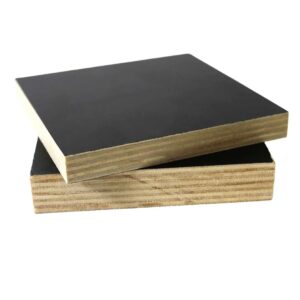
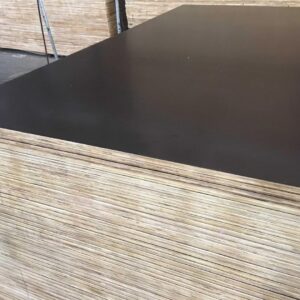
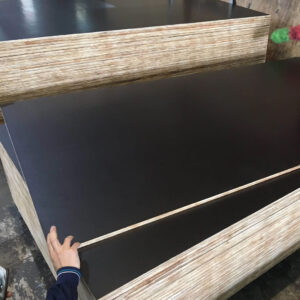
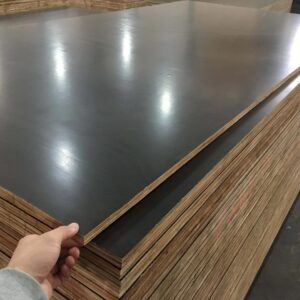
Film faced plywood, also called shuttering plywood or formwork plywood, is plywood pressed with a phenolic surface film (PSF) on both faces. The film gives the panel a smooth, water-resistant surface that releases cleanly from set concrete, so the same sheet can be poured against again. Woodbase makes it in Vietnam on acacia and eucalyptus cores, with a brown film and the edges sealed in black or brown paint.
Our standard film faced plywood is built for concrete shuttering at a sensible cost: one panel can be used about 4 to 6 times, on both sides, before it is replaced. That reuse is what saves the contractor money compared with timber boards or one-off plywood.
Specifications
| Core | Acacia, eucalyptus or combined hardwood |
| Surface | Phenolic surface film (PSF) on both sides, brown |
| Edge Sealing | Black or brown |
| Size | 1220 × 2440 mm, 1230 × 2440 mm, 1250 × 2500 mm, or cut to size (+/- 0.5 mm per metre) |
| Thickness | 11.5, 12, 15, 17, 18 mm (+/- 0.2–0.5 mm) |
| Glue | WBP, melamine, MR, phenolic |
| Formaldehyde Emission | E0 / E1 / E2 |
| Density | 600–615 kg/m³ |
| Moisture | ≤ 12% |
| Reuse | About 4 to 6 times, both sides |
Where It Is Used
Film faced plywood is the shuttering board for concrete walls, columns, beams and slabs, on high-rise buildings, bridges and civil works alike. Because the film keeps water out of the veneers, it is also used for flooring and scaffolding platforms on site. The 18 mm and 15 mm thicknesses carry most slab and wall formwork; 12 mm and 11.5 mm are used where the panel is backed by closer-spaced timber or steel. Compared with timber boards, one film faced panel covers a larger area, sets up and strips faster, and leaves a smoother concrete surface that needs less plastering afterwards.
How Many Times Can It Be Reused?
Our standard film faced plywood is designed to be used 4 to 6 times, counting both sides of a whole sheet. The real number on your site also depends on how the panels are stored, the construction method, the concrete mix, and how carefully the panels are handled, cleaned and stripped. Store panels flat, off the ground and under cover, clean them after each pour, and avoid cutting through the film where you do not need to: an exposed cut edge lets water into the core.
Choosing the Glue
The glue sets how well the panel stands up to water. Phenolic and WBP (weather and boil proof) glue hold the layers together through repeated wetting, so they suit formwork that is used many times or left outdoors. Melamine glue is a cost-saving choice for fewer pours, and MR glue for dry or short-term use. Edge sealing matters as much as the glue: the panel edges are sealed in black or brown paint so that water cannot soak into the core between pours. Tell us how many pours you need and we will recommend the glue.
Packing and Container Loading
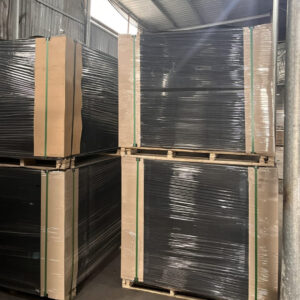
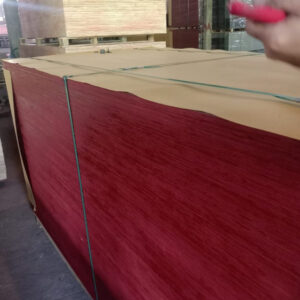
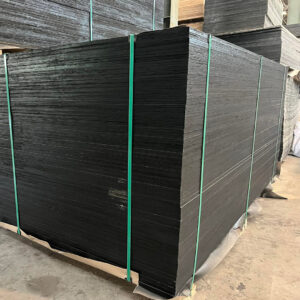
Panels are packed in crates with metal straps and loaded into the container by forklift. A 40ft HC container takes about 16 crates and 40–46 m³ per 40ft HC, depending on thickness.
| Thickness | Panels per Crate |
|---|---|
| 12 mm | 82 |
| 15 mm | 65 |
| 17 mm | 58 |
| 18 mm | 55 |
Ordering from Vietnam
The minimum order is 10 × 40ft HC, and we can supply about 30 × 40ft HC a month, paid by T/T or L/C, FOB Hai Phong or CIF. Under the EVFTA, Vietnamese plywood enters the EU at 0% tariff, and FSC certified plywood is available: see our certificates. For the full range, read our overview of plywood from Vietnam, or see Packing Plywood for crates and pallets, Commercial Plywood for general use and Furniture Plywood for cabinets and tables. Send us the size, thickness, glue, edge colour, quantity and destination port for a quote.


